Friday, December 5, 2014

THE COLD WEATHER IS UPON US AND SO ARE THESE OCCASIONAL INVADERS


RATS


In the Northeastern U.S. there is only one species of rat that concerns pest control professionals. This species is the Norway Rat. The Rat is nocturnal by preference but can adapt this behavior if the environment causes it to do so. They have many similarities with mice but there are some startling differences. Norway rats are larger than mice, usually weigh between 12 and 16 ounces, have small ears that are close to the head, and a blunt nose. Both mice and rats are very destructive in their behavior by gnawing with their incisors on fabrics, walls, wires, and other surfaces. The rodent droppings and urine's will contaminate any surface.  Most importantly they are vectors of disease. 


MICE


Mice are the most successful mammal on earth in terms of survival, second only to man. Mice can be found inhabiting any environment people will inhabit. They can reproduce in large numbers very quickly and give us great cause for concern both from a public health and from a pest control standpoint. In New York City and Nassau County they may find entry into home through small opening around garage doors, pipelines, and siding.


Mice are curious animals with poor eyesight but they have an excellent sense of smell and hearing, and use their vibrissae (whiskers) as tactile (touch) organs. These animals prefer small-enclosed spaces in which to function. This type of area gives them security against enemies. Their home range (distance traveled from nest to forage) is 30 feet or less, but will travel further in search of food. Mice are capable of spending their entire lives within a 3-foot diameter if all of their needs can be met in this space.


CRICKETS


Certain crickets occasionally invade homes and become a pest by their presence. Homeowners in the Bronx, New York City, Queens, Brooklyn, and Nassau County in Long Island complain of the monotonous chirping of the House and Field Cricket, which can be annoying especially at night when trying to get some sleep. The more common Camel Back Cricket doesn't make any noise, but will put a fright into you when it happens to jump across your face while watching TV! 


Indoors, some crickets can feed on a wide variety of fabrics, foods and paper products. An occasional cricket or two in the home usually presents no serious problem. However, large populations may congregate around lights at night, making places unattractive. 
 
Visit us on the web at www.MagicExterminating.com
 
#rats #crickets #mice


Thursday, November 6, 2014

Camel Crickets


Camel Crickets


Camel crickets and closely related cave crickets belong to a large group of insects. Unlike many other types of crickets, the camel crickets do not chirp.  They have no sound producing organs.

Camel crickets have an unusual humpbacked appearance with heads that are bent downward between their front legs.  Their antennae are much longer than their bodies and their large hind legs make them very strong jumpers. 

Habits and Habitat. Most of the crickets in this group are active at night and are attracted to areas with high humidity and moisture.  Outdoors camel crickets and their cave cricket cousins are found in wood and stone piles, tall grass and weeds, hollows of trees, holes in the ground, and of course, caves.  If found indoors, camel crickets often will be in damp basements, crawl spaces, or garages.

Moisture is an important requirement for camel cricket survival so reducing the number of moist habitats is essential for good, long-term control. Preventing access to the structure is also important. 

If camel crickets are still a problem after taking habitat altering steps to reduce moisture and access to the structure, outdoor chemical control may be necessary. 

Tuesday, July 15, 2014

Carpenter Ants

Carpenter Ants trailing on building


Carpenter ants are the most common ant pest found in the Northeastern United States. They cause structural damage when they excavate wood for nest sites. Unlike termites, carpenter ants do not eat wood, but rather scavenge on dead insects and collect sugary secretions (“honeydew”) produced by other insects such as aphids. Carpenter ants are a nuisance pest when workers are spotted inside foraging for food and when winged swarmers are found inside.

Carpenter Ant Factoids

Carpenter Ants hollowing out wood.
Wood is Not-So-Tasty: 
Carpenter ants tunnel through moisture-damaged wood and spit out wood shavings. The resulting waste piles look like sawdust and often include ant body parts.

A Numbers Game:
There are approximately 24 species of carpenter
ants that are pests in North America; nine of these species are present in the northeast.

Hanging Out:
Carpenter ant larvae are clumped together by J-shaped hairs, and cling like Velcro to the roof of their galleries.


Friday, July 11, 2014

German Cockroach

Figure 1. Adult female German cockroach, Blattella germanica (Linnaeus), with ootheca. Photograph by James Castner, University of Florida.
Figure 2. German Roach Stages
                      

Life Cycle
The German cockroach has three life stages typical of insects with incomplete metamorphosis: the egg, nymph, and adult. The entire life cycle is completed in about 100 days. However, factors such as temperature, nutritional status, and strain differences may influence the time required to complete a life cycle. German cockroaches breed continuously with many overlapping generations present at any one time. Under ideal conditions, population growth has been shown to be exponential. Actively growing field populations are comprised of 80 percent nymphs and 20 percent adults. The German cockroach is omnivorous, eating table scraps, pet food, and even book bindings.

Medical and Economic Significance

German cockroach’s adulterate food or food products with their feces and defensive secretions, physically transport and often harbor pathogenic organisms, may cause severe allergic responses, and in extremely heavy infestations have been reported to bite humans and feed on food residues on the faces of sleeping humans. In addition, some scientists suggest that German cockroach infestations may cause human psychological stress and that the stigma associated with infestations alters human behavior. For example, people with infested houses do less entertaining, and avoid the kitchen at night for fear of encountering a cockroach. 

For more information visit us at www.MagicExterminating.com 

Tuesday, June 17, 2014

Pavement Ants


Pavement Ants
 Pavement ants are 3/16 of an inch. Workers are about half as long as one of your shirt buttons is wide. They are dark reddish-black and have antennae that bulge out at the tips so they look like they’re waving little clubs off their foreheads.


Where it lives: Pavement ants most often nest under bricks or pavement, but they are also found in grassy areas near sidewalks and even in extreme environments, like salt marshes.

What it eats: Ultimate opportunists, pavement ants eat anything from dead insects to honeydew, a sugary food planthoppers produce. They also dine on pollen, food in your kitchen, and garbage.

NYC notes: Here is an ant with a New York ethos. It is, we suspect, more common beneath the cement of sidewalks and roads than anywhere else. Something about the cement becomes it. It’s a possibility that they may like the heat, the vibration of the road, or being close to New York’s exciting human life.


For more information visit us one the web at www.MagicExterminating.com

Monday, June 2, 2014

Pest of the Month- Carpenter Bees


Fig. 1. A carpenter bee visiting a flower. Note the yellow hairs on the thorax and the shiny black abdomen, which is hairless. (Photograph Tom Murray www.pbase.com/tmurray74 )


Fig. 2. A section of wood cut in half to expose the chambers or cells constructed by a carpenter bee. (USDA Forest Service Archive, USDA Forest Service, www.Bugwood.org)

Injury: Carpenter bees bore into wood to make a home for their young. In preferred sites, bees can drill a large number of holes. They are holes 1/2 inch in diameter. Often the same nesting sites are used year after year, and the same tunnels are reused. Porches, garages, shed ceilings and trim, railings, roof overhangs and outdoor wooden furniture, are all common nesting sites. Continued borings may weaken some wooden structures, and the yellow "sawdust and pollen" waste materials may stain cars, clothing, or furniture.

Behavior: The males are territorial, and in the spring they often guard the potential nest sites. They discourage intruders by hovering or darting at any moving thing that ventures into the nesting area. This can create a "human annoyance" factor, and it is one that often startles and concerns the homeowner.

However, male carpenter bees do not sting. The female carpenter bee, like many other bees, can sting - but it is uncommon for her to do so.

Friday, September 27, 2013

NPMA Technical Update: The Importance of Bed Bug Salivary Glands

NPMA Technical Update: The Importance of Bed Bug Salivary Glands

Drs. Jerome Goddard and Kristine Edwards of Mississippi State University have investigated the effects of bed bug saliva on human skin. Secretions from salivary glands have long been thought to be the cause of dermal reactions among certain people bitten by bed bugs, but there was insufficient supporting evidence. The scientists were able to demonstrate the role of saliva by removing the salivary glands of bed bugs and allowing them to feed on a person known to produce a dermal reaction upon being bitten. Although the volunteer could feel the bite of a bed bug that lacked salivary glands, the bug was unable to feed and her skin did not react as it did to a normal bed bug bite. In a second experiment, a salivary extract was prepared from bed bugs and applied topically to the volunteer's skin. Within 36 hours, the volunteer reported itching and a visible dermal reaction. This research presents strong evidence that salivary glands are important to both feeding and likely contain allergens that can cause adverse reactions in victims.  

This paper, "Effects of Bed Bug Saliva on Human Skin", was published in the American Medical Association Journal of Dermatology in March of 2013.

Tuesday, March 26, 2013

Winter Ants by Ralph H Maestre BCE


Winter Ants by Ralph H Maestre BCE

Lasius niger Black Garden Ant
A potential pest ant is the Black Garden Ant, Lasius species, which has workers approximately 2-5 mm in length and is monomorphic (all the same size). They have several different species with various body colors. Black Garden Ants are found throughout the US. This ant forms mega-colonies with multiple queens.
They tend aphids for honeydew and eat living and dead insects. They love sugar-based products inside home. The colony size may reach over 15,000 ants and cover very large areas. One colony in Europe covered northern Spain, southern France into northern Italy. That is like saying one colony covering an area from New York City south to Washington DC. This may be an exaggeration but you get the idea. Anything you do on a property may only be like trimming the finger nails on a human. The body is so large that the nails just grow back. This is to say that the colony will bounce back very quickly. A very aggressive approach to pest control including both the inside and outside of the property would be required.

Prenolepis impairs False Honey Ant or Winter Ant
The winter ant is in reference to its foraging at temperatures barely above freezing during the cooler months. False Honey Ant is an unfortunate name, since the storage product in the corpulent young workers of these ants is fatty, not sugary. The body lengths for the worker is 2.5-3.5mm, the queen about 8mm, male 3-4mm. The ant has a very shiny head, thorax, and abdomen very dark brown in color. The legs and antennae of live specimens are medium brown at base, smoothly shading to pale yellow at tips (this color arrangement gives the overall impression of an insect that is very dark in the middle and very pale at the extremities). The range for the winter ant is most of the United States, plus southern Ontario and Mexico. This ant usually nests in the soil with some clay content in wooded situations or occasionally constructing a chamber under a rock or log. This ant is often associated with oak woodlands of various sorts (or scrub oak thickets in the west), but also (beech-) maple.

The winter ant often build their nests deep underground, staying inactive during the summer months, and returning to activity when the weather cools. They are the earliest to swarm of our cool climate North American ants.

The workers feed on honeydew, secretions of flowers, sap flows, exudates from galls, earthworms and arthropods (usually as carrion), and ripened or decaying fruit. The life cycle o f the males and females are reared in late summer, then overwinter in the underground nest, and take their nuptial flights in the spring. Young workers are "overfed" and swell with fat, from which a nutritious glandular secretion is produced. This becomes the main food upon which the year's single brood of workers and alates (winged ants) are reared.

Pachycondyla chinensis Asian Needle Ant

One of the few ants that are specialized for cold temperature foraging; they can be found foraging even at near freezing temperatures, where they are often the only ants visibly active. However, their range does not extend into the far north, despite their cold tolerance.

Pachycondyla chinensis, the Asian needle ant, was first detected in the United States in Dekalb County, Georgia in approximately 1932. This species is an average sized, dark brownish-black ant with an evident stinger. It is considered an invasive species that establishes large populations that may displace native species. Reactions in humans from the sting o this exotic species range from mild to severe, sometimes with long lasting symptoms. Consequently, the Asian needle ant poses an emerging health threat throughout its range, as well as areas to where it may be spreading. However, it is not overly aggressive. Stings typically result from handling workers or by winged queens landing on individuals and becoming trapped between clothing layers and skin.
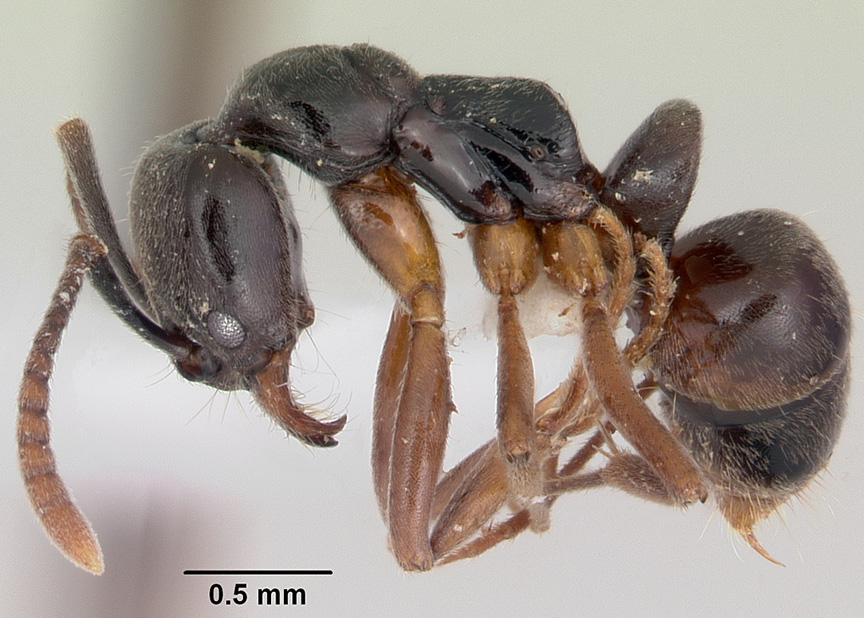
Asian needle ant typically nests in soil in somewhat damp areas, especially below stones, in rotting logs and stumps, or other debris. In urban settings it may also be found under mulch, railroad ties, bricks and pavers. Colony size ranges from less than 100 individuals to several thousand, and multiple queens may be present. Unlike many introduced, invasive ant species, it can nest in natural wooded habitats. This species appears to prefer termites as a food source.

This introduced species is thought to have been introduced from Japan. In the United States it is known to occur in Alabama (MEM record), Connecticut, Florida, Georgia, South Carolina, New York, North Carolina, Tennessee, and Virginia.

Sources:
Mississippi State Entomological Museum, Asian Needle Ant
Wikipedia, False Honey Ant or Winter Ant

Tuesday, June 19, 2012

Ant Control Techniques by Ralph H Maestre BCE

Ant control can and will be difficult to obtain. Ants still remain the number one pest on most pest management professional lists. Many methods are employed to control them and many fail. Long term methods generally employ exclusion or pest proofing. I will explain some of the current methods used by MPM. First I will give a very brief introduction of the different ant species we deal with and then speak on the control techniques.

Carpenter Ants· Small minor workers ¼ inch long
· Large major workers ½ inch long
· Large black or reddish ant
· Polymorphic (multiple sizes in the colony)

One the most prominent species of ants we encounter is the carpenter ant. There are several species, but all are treated in the same way by us. Carpenter ants are among the largest ants found in homes and live in colonies containing three castes consisting of winged and wingless queens, winged males and different sized workers. Winged males are much smaller than winged queens.

Swarmers emerge from mature colonies usually from March to July. The colony does not produce swarmers until about three years later. A mature colony, after three to six years, has 2,000 to 4,000 individuals. Workers regurgitate food for nourishment of the developing larvae and queen.


In later generations, workers of various sizes are produced (polymorphism) into major and minor workers that are all sterile females. Nests are usually established in soft, moist (not wet), decayed wood or occasionally in an existing wood cavity or void area in a structure that is perfectly dry. The walls of the nest are smooth and clean (sandpapered appearance) with shredded sawdust-like wood fragments, like chewed up toothpicks (frass), carried from the nest and deposited outside.


The most important and often most difficult part of carpenter ant control is locating the nest or nests. Once the nest location is found, control is very easy and simple. Steps to a successful inspection include an interview with family members, inspection indoors, inspection outdoors and sound detection.

Pharaoh Ants· About 1/16 inch long
· Light yellow to reddish brown with abdomen slightly darker
· Monomorphic workers
· Has two nodes and no spines on the thorax
· No stringer
· Three segment clubbed antennae


Female Pharaoh Ants can lay 400 or more eggs in her lifetime. Mature colonies contain several queens, winged males, sterile females or workers, eggs, larvae, prepupae and pupae growing to as large as 300,000 or more members.
Periodically a queen, together with a few workers carrying immatures (eggs, larvae and pupae), leaves the nest and sets up a new colony elsewhere, quickly spreading an infestation. This behavior pattern is known as "satelliting," "fractionating" or "budding" where part of the colony migrates to a new location rather than by single females dispersing after a reproductive swarm. Budding may occur due to overcrowding, seasonal changes in the building's central heating and cooling system or application of a repellent pesticide (really known as fission).

Nests usually occur in wall voids, under floors, behind baseboards, in trash containers, under stones, in cement or stone wall voids, in linens, light fixtures, etc.

Pharaoh ants are usually much harder to control than other ants because of their ability to disperse. About 90 percent of the colony remains hidden in the nest so even if 10 percent of the colony is killed by a residual pesticide, the remaining reservoir of ants is enormous. Conventional contact pesticide applications especially repellent products such as pyrethrins may spread infestations to new areas with multiple colonies blossoming within the structure. These ants will avoid certain pesticides.

Odorous House AntsBrown coloration
Body 1/8 inch in length
Workers are all one size (monomorphic)

Colonies vary in size and range from a few hundred to 10,000 individuals, usually with multiple queens. Sexual forms are produced only in colonies that are at least four to five years old. Mating may take place within the nest or nearby. Colonies multiply when one or more fertile females accompanied by numerous workers leave the parent colony, found a new nest, and start a new colony. Single inseminated queens from nuptial flights also may establish new colonies independently.

The odorous house ant, Tapinoma sessile (Say), is a native species that occurs throughout the United States. Outside, it commonly nests in soil beneath most any object, including stones, logs, concrete blocks, and fallen limbs. It also nests under the bark of logs and stumps and in plant cavities, refuse piles, under mulch in flower beds, and nests of birds and animals.
It is critical to survey inside and outside to locate all nests. Nests found outside can be drenched with a residual insecticide. When numerous ants appear around the building foundation, a perimeter treatment with a residual non-repellent insecticide should be used. Baits that have a protein or sugar-based attractant may be effective when the nest is not accessible.

Magic’s Management Program always begins with baiting. Use the various baits we have available like Intice gel, Intice granular, Advance gel, Advance 388B, Advance granular, Advion Pucks, and the new Advion gel. All of these are highly effective bait. Use the buffet style of baiting, this means don’t rely on only one of the baits. You will fail and numerous call-backs will occur. In conjunction with this you may use only a liquid spray, such as Phantom. Use Phantom both outside and inside the perimeter of the structure. This is a non-repellent and is effective. There are new products Fast-out foam and Transport GHP new to our arsenal. These products are showing very good results and are also non-repellents. NyGuard is an IGR that can and should be incorporated into our pest management program against ants. NyGuard may be used with both non-repellents and baits.

Termidor is to be used only by the field supervisors. This is a last resort situation.When it comes to carpenter ants, if the nest is located then we will drill and inject product using the actisol machine or dust. The dust may be Drione, Tri-Die, or Borid. Repair to leak can be handled by our carpentry division.

Nest found outside, small mounds of dirt, may be sprayed using pyrethroids. This is the only time you may use one of these products. Phantom cannot be used always from the structure. Always read your labels and provide them to the customer.

If a follow-up is needed, then it should be no less than ten to fourteen days later. This will allow for the product to take effect.


Potentially two other species may be found in our area that enters structures. The first one is the False Honey Ant, Prenolepis impairs, the workers are monomorphic, 2 to 4 mm long, and have a one-segmented petiole. Also known as the small or winter ant is found throughout the US and often associated with Oak trees (Gregg 1963; Ebeling 1975; Wheeler and Wheeler 1986). They like damp soil in shady places and are usually the first ants seen in the spring time.

Treatment consists of gels or baits with dust being used in void. Direct liquid treatment to nest site is recommended.

The other potential pest ant is the Black Garden Ant, Lasius species, has workers approximately 2-5 mm in length and is monomorphic. They have several different species with various body colors. Black Garden Ants are found throughout the US. This ant forms mega-colonies with multiple queens. They tend aphids for honeydew and eat living and dead insects. They love sugar-based products inside home. The colony size may reach over 100,000 ants and cover very large areas.

One colony in Europe covered northern Spain, southern France into northern Italy. That is like saying one colony covering an area from New York City down to Washington DC. This may be an exaggeration but you get the idea. Anything you do on a property may only be like trimming your finger nails. The colony will bounce back very quickly. A very aggressive approach would be needed and only a service manager with the technician can ascertain what the proper approach would be.

Thursday, June 7, 2012

Non-toxic Rodent Bait Blocks


By Ralph H Maestre BCE


Non-toxic baits also known as monitoring/tracking baits (MTBs) are being used as part of our “Green Certified Services”, in our Park Jobs, and Food Processing Programs in an effort to reduce overall rodenticide use and following integrated pest management (IPM) principles. Magic has been introducing non-toxic baits into other aspects of our daily pest management programs. Magic uses only the product known as DETEX® Blox with Biomarker by Bell Labs®. After reading a recent article in the Techletter by Pinto & Associates’ May 27th, 2012, I thought it would be a good idea to share it with you. Non-toxic rodent bait blocks are used for many different reasons and the article listed 18 of them. My opinion is marked of by the Bold, Italic, and Underline:


1. Because they are non-toxic, blocks can be placed in areas where toxic baits may not be permitted. There are minimal safety or regulatory concerns, and no worries about non-target poisoning or bait translocation. This will reduce the chances of secondary poisoning in all our baiting programs. Our clients have strong concerns regarding their pets and wildlife such as hawks. Magic cares and we show this by only using rodenticides when and where required.


2. Limiting the use of toxic bait and increased reliance on monitoring for rodent activity appeals to customers who want an integrated pest management component. Biomonitoing for rodent can be part of your “green” service offerings. Without any doubt, this is a very important point of the “Certified Green Shield Services” we are offering to customers.


3. The presence of rodent tooth marks on non-toxic blocks placed in bait stations and other sites provides positive evidence of rodent infestation that can be presented to the customer. You can even give blocks to customers for placement so they can check for gnawing activity themselves. It is our company policy not to give our clients materials. If they request it, we will place it in tamper resistant bait stations for them and service the equipment. Gnawing either non-toxic or toxic bait will provide positive evidence of rodent activity.


4. Use of non-toxic blocks in pre-baiting programs helps overcome bait shyness. It gets the rodents used to feeding on an actual bait block, rather than people food, to make the transition easier when you substitute toxic blocks. It’s best to use the same manufacturer’s rodenticide so that the shapes of the block and food base are the same. Magic does use the same manufacturer. Remember this may require some time before the rodents are re-trained to feed on bait blocks if they became bait shy. Our customers will need to be educated about this process.


5. Non-toxic blocks can be used to pinpoint active feeding sites, telling you where to concentrate your control efforts. Bait sites where you suspect rodent activity and check back a few days later to see which blocks have the most gnawing tooth marks. Make note of these locations because this is where you should place your toxic baits or traps. If the blocks are untouched, don’t bother baiting or trapping there. Make more placements in sites with the greatest amount of feeding. In an IPM program using non-toxic bait will promote reduce pesticide usage and provide minimum risk to non-target mammals.


6. You’ll use less rodenticide because pre-baiting with MTBs will have located travel routes and harborage sites where toxic baits can be concentrated, giving the best results and wasting less bait. Reducing the use of rodenticide in and around our client’s establishments is our goal while targeting the problem areas. This is the responsible direction that Magic is taking.


7. Non-toxic blocks help you determine the size of the population by gauging the amount of feeding. Is there a lot of gnawing or only a little? Do you have to replace blocks that were completely eaten? The amount of dyed droppings also gives clues about the size of the infestation. As our professionalism grows with education, we will be able to outperform our competition by finding the source of the rodent problems quickly and not just masking it.


8. Monitoring blocks can be used to track the movement of rodents through their dyed dropping to help determine where to place traps or toxic bait. You can assess travel routes or runways, travel distance, nest locations, and entry points by observing droppings. Place MTBs in ceiling voids to determine whether rodents are active in these spaces. Although other methods may be used such as visual inspections, sometimes we lose the path to where they nest because the rodents disappear into a voids and exist elsewhere. Using rodenticides straight up may cause the rodent to become disoriented and give us false trails back to their nest or entry points.


9. Find rodent entry points using MTBs. To determine whether rodents are moving into facility from outside, place MTB-baited stations only on the outside. Dyed dropping seen inside will confirm that rodents are moving in from outside. This is one of the most important points. When we find the entry point and exclude it we solve pest problems.


10. Use the blocks for ongoing monitoring in sensitive accounts. In food facilities and warehouses, for example, use the blocks as early warning signs to identify incoming rodent infestations, and to gauge the success of your controls. More and more regulations will require us to document how we perform our rodent control programs. By monitoring and documenting our decision process will separate Magic from our competitors as highly professional and responsible.


11. Maintain baiting continuity in an ongoing rodenticide baiting program by replacing bait at inactive stations with MTBs. This allows you to keep the station in place and on your map and converts it to a temporary monitoring station ready to revert back to toxic bait when activity is noticed. A good point in reducing our overall rodenticide use yet maintaining a program that allows us to document and quickly introduce the rodenticide without creating bait shyness. Less paperwork in our logbooks since we will not have to replace or modify our maps. This will result in quick control of an emerging rodent problem.


12. Use the blocks as part of UV blacklight inspections. We already use UV light to detect rodent urine, but now the dropping of rodents that have fed on DETEX with Biomarker will also glow neon green under UV light. Using a handheld blacklight to track rodent movement gives an added component to inspections. This will provide quicker inspections, reducing callbacks, and initiation of quicker rodent controls. In dark areas where we have a hard time distinguishing between small particles and rodent droppings, the Biomarker will allow us to save time and confirm rodent pathways.


13. Improve trapping results by adding MTBs to snap traps, glueboards, or multi-catch rodent traps. The blocks serve as a food bait to entice rodents to the traps and also keep rodents alive until multi-catch traps can be serviced. This may provide limited results since most rodents will die first from stress or hypothermia while inside a mutli-catch devise. It may be useful on large rat mats.


14. MTBs can help determine whether burrows are active. Use a blacklight to see if dropping in the burrow fluoresce (DETEX only). Since many of us cannot tell if a rodent burrow is active this may be useful.


15. With practice, you can read the gnawing on the block baits to identify the pest and any non-targets feeding. Rodents gnaw at the edges of the block while insects will eat depressions in the block. Mouse gnawing leaves fine lines on the edges while rats leave larger and more distinctive tooth marks or grooves. This will occur on either non-toxic or toxic bait. The education is valuable. Each of you should take notes and learn this point.


16. Survey sewers by wiring the block to the manhole cover or top rung of the ladder and dropping it down onto a ledge (don’t enter the manhole unless you have had confined spaces training and are in compliance with all rules). We rarely service the sewers manholes directly. We do service the catch basins, so this point applies directly to catch basins.


17. MTBs are exempt from EPA’s new rodenticide label changes. You can bait burrows with MTBs and can bait any distance from a building, along fencelines, wherever. Using MTBs for perimeter baiting means you are not killing other non-target small mammals. This is very important since many of our clients desire tamper resistant bait stations along the fencelines on their properties. This allows us to monitor activity and find the burrow system quicker than just monitoring along the perimeter of the home or building structure. At times rodent problems occur in an open fieldor groundcover are that the new label laws prohibit from using bait stations with rodenticides. An active trapping program would have to be used.


18. Cockroaches will feed on MTBs and their droppings also glow under blacklight. Use DETEX bait blocks in suspect areas to track the movement of American cockroaches, through their droppings, to determine whether or not they are coming from sewers or basements. This will also reduce rodenticide waste and or possible spillage.


As you can read, there is a lot that is offered by using the DETEX® Blox in a rodent program. All 18 point where taken from the May issue of Techletter by Pinto & Associates. More information may be obtain at www.techletter.com

Wednesday, May 23, 2012

Spring is here and summer is approaching fast.

Unfortunately, this means Bed Bugs activity will be on the rise. According to Cornell University "Under ideal conditions bed bugs feed regularly when temperatures are above 70° F.... Eggs are not deposited at temperatures lower than 50° F.... At 65 degrees, bed bugs take their time developing, taking three months to become adults. But as the temperature increases, their maturation process accelerates. At 86 degrees, the three-month maturation period shrinks to only three weeks."

Bed Bugs also like to Travel. 

Summer is vacation time and hotels become more susceptible to guest spreading infestations. This means you are more likely to bring home an unwanted guest from your vacation.
You do not have to travel far to get bed bugs. Were ever humans are so are bed bugs as we do more activities were people congregate the possibility of coming into contact with bed bugs increases... movie theatres, museums and public transportation can be hot spots.

The Bed Bug Book gives helpful tips on Prevention and if need be Eradication.

Arm yourself with The Bed Bug Book and Protect your. Available on Amazon.com (click here) and BarnesandNoble.com


Wednesday, February 1, 2012

Pest Management Profesional gives nod to The Bed Bug Book

Pest Management Professional December 2011 edition gave Ralph's book "The Bed Bug Book" a thumbs up under there "Solutions Showcase" section on page 58 (see excerpt below).

Tuesday, January 3, 2012

ESA Entomology 2011 Confrence

Entomological Socity of America's annual confrence was held in Reno Nevada this year. Our very own Ralph H. Maestre BCE attended along with Lynn Frank BCE of Suburban Exterminating.

This years hot topics were Identify Clarify and Speak Out -- reflecting the need for entomologists to inform others about exactly what it is that we do and don’t do, since arthropods touch the lives of every person on the planet, every day, in both positive and negative ways.

Ralph with Dr Dini Miller of Virginia Technical Institute

Ralph and Lynn enjoy a few free moments exploring Reno

Wednesday, August 24, 2011

Weapons of Mouse Destruction: How to Eliminate Relentless Rodents

This article appeared in Popular Mechanics authored by Adam Hadhazy

There are plenty more ways beyond the traditional mousetrap to get the rodents infesting your house. We survey the best ways homeowners and exterminators can solve a mouse problem. By Adam Hadhazy Popular Mechanics

The Mouse: It's a pest that has been invading human living spaces ever since we holed up in caves. The hardy creatures require little food and virtually no water, allowing them to thrive in modern buildings, behind our walls and under our floors.

Although cute and squeaky in the wild, mice are a dangerous nuisance in the home. The critters chew up insulation and gnaw through electrical wiring, creating a fire hazard. Mice can contaminate food with their feces. They carry fleas and diseases. Many people are allergic to the animal's urine. To top it off, the rodents breed prolifically; in several weeks a few mice can become a dozen.

Mouse intrusions happen year-round, but tend to spike in many parts of the country in the summer months and late fall, according to Ralph H. Maestre, technical director at Magic Pest Management based in Flushing, New York. Exterminators have developed a full arsenal of methods to kill, capture and control the millions of rodents, mostly mice, who aim to set up shop in our homes and businesses, from the simple and iconic mousetrap to far more elaborate attacks. Here's a look at the weapons of mouse destruction.


Kill Zones: Front-line Traps: The traditional way to fight mouse infestation is with traps. Inquisitive mice can't help but check them out, especially if there's bait. "Mice are very curious about the new things in their environment," says Jim Fredericks, director of technical services for the National Pest Management Association.

Traps come in three basic varieties. First, classic snap traps, whose invention dates back to 1894. "To this day, the original old-fashioned snap trap is one of the most effective traps we have," Fredericks says. While going for the bait in these traps, the mouse steps on a trip and, SNAP!, a spring-loaded bar slams down with backbreaking force.

A second class, glue or sticky traps, uses strong adhesives to ensnare mice. (However, glue traps have raised the hackles of some animal-rights proponents, as stuck mice will sometimes chew through their limbs or rip themselves apart trying to break free.)

A third and less gruesome option is multiple-catch or live traps. Through mechanical means-spring-loaded doors, flippers, teeter-totter-like levers and the like-the traps capture several mice in a storage area. The spared vermin can then be deposited far from the dwelling to keep them from coming back.

As for the choice of bait, skip the traditional cheddar cheese. "Mice really like seeds, chocolate, peanut butter and bacon," says Greg Baumann, Orkin technical services director


Mousetraps 2.0: Unconventional Killing Machines"Building a better mousetrap" isn't just an adage. Exterminator pros are always trying to come up with better ways to catch rodents.

The Rat Zapper by AgriZap uses ordinary food bait to lure a mouse or rat, just like a traditional mousetrap does. But then the device zaps the rodent to kingdom come, courtesy of four D batteries. Victor makes various electronic mouse traps as well, including one that can catch and fry 10 mice.

Another alternative trap is the NOOSKI, made in New Zealand. As a mouse enters the trap, it must stick its head through a rubber ring-which instantly contracts and suffocates the little bugger.

Perhaps the most advanced mousetrap around is the RADAR (Rodent Activated Detection And Riddance) device by U.K. company Rentokil Pest Control, geared for commercial use. When a mouse scampers into RADAR's tunnel and crosses two consecutive infrared beams, the trap seals shut and floods the chamber with a deadly dose of carbon dioxide. As a courtesy, RADAR notifies its owner via text message when the deed is done.


Poisons: Gobbling Down Some Sweet Death If traps don't take care of your mouse problem, maybe it's time to switch to chemical warfare. Poisonous baits sold in pellet form, or in newer putty formulations, turn the natural tendency of mice to gnaw and nibble against them.

So-called rodenticides come in a number of varieties, but the most common are anticoagulants. These compounds cause internal hemorrhaging, ending a mouse's life in a few days. If you choose this route to kill mice, however, keep a supply of vitamin K1 around: It's an antidote to the anticoagulants that you can give to cats and dogs if they eat the poison, Fredericks says.

Other creative chemistries for dispatching mice include metal phosphide-laced baits, he says. When zinc phosphide reacts with the acid in a rodent's stomach, highly toxic phosphine gas forms. Vitamin D is another killing agent. The vitamin makes mice absorb too much calcium from their food, while leaching the mineral from their bones. The resulting hypercalcemia (excessive levels of calcium in the blood) damages the heart, kidneys and other organs.

Fredericks points out that all pesticides, including rodenticides, must be approved by the EPA and are regulated by state agencies. In other words, custom cocktails are not available. "Pros definitely don't make their own secret recipe," he says.


Tracking Tech: Seek and Destroy Mice are frustratingly elusive, nibbling on food left out at night and vanishing during the day. But, unbeknownst to the rodents, they leave signs that reveal their movements. Those signs just happen to be in UV. Mouse urine fluoresces in UV light, so shining a black light around can show where the rodents pee. "The use of black lights is really a great inspection tool," Fredericks says, though it takes a trained eye to discern genuinely glowing mouse urine from splashes of, say, floor-scrubbing detergent.

Simply leaving traps wherever you find mouse droppings might not be the best approach, though, says Douglas Stern, managing partner at New Jersey-based Stern Environmental Group. His company developed a fluorescent powder that could help you track mice back to their nests. "When the mice walk on the powder, they get it on their feet and it leaves a footprint," Stern says. To get the powder onto the mice, load it into a box with food or dust it onto cotton balls, which the mice nab as nesting material. Then follow the footprints, which appear under UV, to find where the mice have set up shop. This lets you set up traps there, or seal off an outside entry point if mice are entering into the house from outdoors.

The so-called Track & Trap system has yet to become widespread, but Stern envisions the product having key niche applications. 'I think it's going to be very popular in instances where you have mice running around and no one knows where they're coming from, he tells PM. Meanwhile, major manufacturer Bell Labs has also started selling rodenticide food pellets doped with chemicals to make mouse feces glow green.

Fight Animals With Animals Release the hounds! Exterminators today are taking a cue from law enforcement and turning to dogs' super sensitive noses for smelling bed bugs, ants and termites. Dogs are just beginning to enter the field of mouse control, Fredericks says, but canines could potentially sniff out rodent headquarters.

Cats, of course, are the traditional nemesis of mice. "I think there's probably a lot of farmers that would swear their barn cats keep the mice out," Fredericks says. But the idea of a house cat attacking your mouse problem is probably more cartoon fodder than reality. A standard domesticated cat that lives in a house is probably not really hungry enough to be interested in killing mice," he says. In fact, Baumann describes a case where mice stole cat food right out of the dish and hoarded it under the stove without the pet so much as raising a paw.

Finally, for those homeowners who aren't like Indiana Jones, snakes are always a fine predatory option. Case in point: Corn snakes, a popular, nonvenomous pet which winds around prey constrictor-style, love dining on mice.

Ultimately, there's no guarantee that a barrage of traps, poisons or high-tech repellents will solve a mouse problem, especially if mice find your home to be a sanctuary. The best approach, then, is one of the simplest: Make your home inhospitable to rodents. "Keep in mind, mice are pretty much like us. They need food, water and a place to live," Baumann says. Eliminate those resources by keeping the house clean and sealed off, and store food in secure containers.

Repellents and Fortifications: Defense is the Best Offense Preventing rodents from infiltrating the home in the first place has become big business. A number of rodent-repelling odorants are sold at hardware and home stores, including Critter Out spray, Fresh Cab Scent Pouches and Shake Away Rodent Repellent Granules that claim to smell like predators, banking on fear to keep mice away. Some people swear by strong scents, such as pine or cayenne peppers, or even dryer sheets. But experts say the effectiveness is questionable.

On the high-tech side, several companies offer ultrasonic repellers that supposedly keep mice at bay with sound waves. These devices send out sound waves above 20 kilohertz, the typical human high-end threshold for hearing, and some modulate between 32 and 64 kHz so undesirable animals cannot adapt. But Orkin's Baumann and others are skeptical. "My favorite is the fact when [manufacturers] say these things will repel insects, rodents, birds-only the bad stuff-but if you have a bird or a dog, it won't be affected," Baumann says. "There might be some promise with these products coming out in the near future, but I've not seen any scientific data to suggest that they actually work."

Simply shoring up a home might be the best way to thwart rodent intruders. Do a residence self-inspection by checking the foundation for holes, and spaces under doors. "If you walk around your house and see any hole that a pencil can fit though, a mouse can fit through," Baumann says. Seal up those holes with caulk, weatherstripping or steel wool, which mice can't chew through. Follow up with regular patrols of your property.