Thursday, November 6, 2014

Camel Crickets


Camel Crickets


Camel crickets and closely related cave crickets belong to a large group of insects. Unlike many other types of crickets, the camel crickets do not chirp.  They have no sound producing organs.

Camel crickets have an unusual humpbacked appearance with heads that are bent downward between their front legs.  Their antennae are much longer than their bodies and their large hind legs make them very strong jumpers. 

Habits and Habitat. Most of the crickets in this group are active at night and are attracted to areas with high humidity and moisture.  Outdoors camel crickets and their cave cricket cousins are found in wood and stone piles, tall grass and weeds, hollows of trees, holes in the ground, and of course, caves.  If found indoors, camel crickets often will be in damp basements, crawl spaces, or garages.

Moisture is an important requirement for camel cricket survival so reducing the number of moist habitats is essential for good, long-term control. Preventing access to the structure is also important. 

If camel crickets are still a problem after taking habitat altering steps to reduce moisture and access to the structure, outdoor chemical control may be necessary. 

Tuesday, July 15, 2014

Carpenter Ants

Carpenter Ants trailing on building


Carpenter ants are the most common ant pest found in the Northeastern United States. They cause structural damage when they excavate wood for nest sites. Unlike termites, carpenter ants do not eat wood, but rather scavenge on dead insects and collect sugary secretions (“honeydew”) produced by other insects such as aphids. Carpenter ants are a nuisance pest when workers are spotted inside foraging for food and when winged swarmers are found inside.

Carpenter Ant Factoids

Carpenter Ants hollowing out wood.
• Wood is Not-So-Tasty: 
Carpenter ants tunnel through moisture-damaged wood and spit out wood shavings. The resulting waste piles look like sawdust and often include ant body parts.

• A Numbers Game:
There are approximately 24 species of carpenter
ants that are pests in North America; nine of these species are present in the northeast.

• Hanging Out:
Carpenter ant larvae are clumped together by J-shaped hairs, and cling like Velcro to the roof of their galleries.


Friday, July 11, 2014

German Cockroach

Figure 1. Adult female German cockroach, Blattella germanica (Linnaeus), with ootheca. Photograph by James Castner, University of Florida.
Figure 2. German Roach Stages
                      

Life Cycle
The German cockroach has three life stages typical of insects with incomplete metamorphosis: the egg, nymph, and adult. The entire life cycle is completed in about 100 days. However, factors such as temperature, nutritional status, and strain differences may influence the time required to complete a life cycle. German cockroaches breed continuously with many overlapping generations present at any one time. Under ideal conditions, population growth has been shown to be exponential. Actively growing field populations are comprised of 80 percent nymphs and 20 percent adults. The German cockroach is omnivorous, eating table scraps, pet food, and even book bindings.

Medical and Economic Significance

German cockroach’s adulterate food or food products with their feces and defensive secretions, physically transport and often harbor pathogenic organisms, may cause severe allergic responses, and in extremely heavy infestations have been reported to bite humans and feed on food residues on the faces of sleeping humans. In addition, some scientists suggest that German cockroach infestations may cause human psychological stress and that the stigma associated with infestations alters human behavior. For example, people with infested houses do less entertaining, and avoid the kitchen at night for fear of encountering a cockroach. 

For more information visit us at www.MagicExterminating.com 

Tuesday, June 17, 2014

Pavement Ants


Pavement Ants
 Pavement ants are 3/16 of an inch. Workers are about half as long as one of your shirt buttons is wide. They are dark reddish-black and have antennae that bulge out at the tips so they look like they’re waving little clubs off their foreheads.


Where it lives: Pavement ants most often nest under bricks or pavement, but they are also found in grassy areas near sidewalks and even in extreme environments, like salt marshes.

What it eats: Ultimate opportunists, pavement ants eat anything from dead insects to honeydew, a sugary food planthoppers produce. They also dine on pollen, food in your kitchen, and garbage.

NYC notes: Here is an ant with a New York ethos. It is, we suspect, more common beneath the cement of sidewalks and roads than anywhere else. Something about the cement becomes it. It’s a possibility that they may like the heat, the vibration of the road, or being close to New York’s exciting human life.


For more information visit us one the web at www.MagicExterminating.com

Monday, June 2, 2014

Pest of the Month- Carpenter Bees


Fig. 1. A carpenter bee visiting a flower. Note the yellow hairs on the thorax and the shiny black abdomen, which is hairless. (Photograph Tom Murray www.pbase.com/tmurray74 )


Fig. 2. A section of wood cut in half to expose the chambers or cells constructed by a carpenter bee. (USDA Forest Service Archive, USDA Forest Service, www.Bugwood.org)

Injury: Carpenter bees bore into wood to make a home for their young. In preferred sites, bees can drill a large number of holes. They are holes 1/2 inch in diameter. Often the same nesting sites are used year after year, and the same tunnels are reused. Porches, garages, shed ceilings and trim, railings, roof overhangs and outdoor wooden furniture, are all common nesting sites. Continued borings may weaken some wooden structures, and the yellow "sawdust and pollen" waste materials may stain cars, clothing, or furniture.

Behavior: The males are territorial, and in the spring they often guard the potential nest sites. They discourage intruders by hovering or darting at any moving thing that ventures into the nesting area. This can create a "human annoyance" factor, and it is one that often startles and concerns the homeowner.

However, male carpenter bees do not sting. The female carpenter bee, like many other bees, can sting - but it is uncommon for her to do so.

Friday, September 27, 2013

NPMA Technical Update: The Importance of Bed Bug Salivary Glands

NPMA Technical Update: The Importance of Bed Bug Salivary Glands

Drs. Jerome Goddard and Kristine Edwards of Mississippi State University have investigated the effects of bed bug saliva on human skin. Secretions from salivary glands have long been thought to be the cause of dermal reactions among certain people bitten by bed bugs, but there was insufficient supporting evidence. The scientists were able to demonstrate the role of saliva by removing the salivary glands of bed bugs and allowing them to feed on a person known to produce a dermal reaction upon being bitten. Although the volunteer could feel the bite of a bed bug that lacked salivary glands, the bug was unable to feed and her skin did not react as it did to a normal bed bug bite. In a second experiment, a salivary extract was prepared from bed bugs and applied topically to the volunteer's skin. Within 36 hours, the volunteer reported itching and a visible dermal reaction. This research presents strong evidence that salivary glands are important to both feeding and likely contain allergens that can cause adverse reactions in victims.  

This paper, "Effects of Bed Bug Saliva on Human Skin", was published in the American Medical Association Journal of Dermatology in March of 2013.

Tuesday, March 26, 2013

Winter Ants by Ralph H Maestre BCE


Winter Ants by Ralph H Maestre BCE

Lasius niger Black Garden Ant
A potential pest ant is the Black Garden Ant, Lasius species, which has workers approximately 2-5 mm in length and is monomorphic (all the same size). They have several different species with various body colors. Black Garden Ants are found throughout the US. This ant forms mega-colonies with multiple queens.
They tend aphids for honeydew and eat living and dead insects. They love sugar-based products inside home. The colony size may reach over 15,000 ants and cover very large areas. One colony in Europe covered northern Spain, southern France into northern Italy. That is like saying one colony covering an area from New York City south to Washington DC. This may be an exaggeration but you get the idea. Anything you do on a property may only be like trimming the finger nails on a human. The body is so large that the nails just grow back. This is to say that the colony will bounce back very quickly. A very aggressive approach to pest control including both the inside and outside of the property would be required.

Prenolepis impairs False Honey Ant or Winter Ant
The winter ant is in reference to its foraging at temperatures barely above freezing during the cooler months. False Honey Ant is an unfortunate name, since the storage product in the corpulent young workers of these ants is fatty, not sugary. The body lengths for the worker is 2.5-3.5mm, the queen about 8mm, male 3-4mm. The ant has a very shiny head, thorax, and abdomen very dark brown in color. The legs and antennae of live specimens are medium brown at base, smoothly shading to pale yellow at tips (this color arrangement gives the overall impression of an insect that is very dark in the middle and very pale at the extremities). The range for the winter ant is most of the United States, plus southern Ontario and Mexico. This ant usually nests in the soil with some clay content in wooded situations or occasionally constructing a chamber under a rock or log. This ant is often associated with oak woodlands of various sorts (or scrub oak thickets in the west), but also (beech-) maple.

The winter ant often build their nests deep underground, staying inactive during the summer months, and returning to activity when the weather cools. They are the earliest to swarm of our cool climate North American ants.

The workers feed on honeydew, secretions of flowers, sap flows, exudates from galls, earthworms and arthropods (usually as carrion), and ripened or decaying fruit. The life cycle o f the males and females are reared in late summer, then overwinter in the underground nest, and take their nuptial flights in the spring. Young workers are "overfed" and swell with fat, from which a nutritious glandular secretion is produced. This becomes the main food upon which the year's single brood of workers and alates (winged ants) are reared.

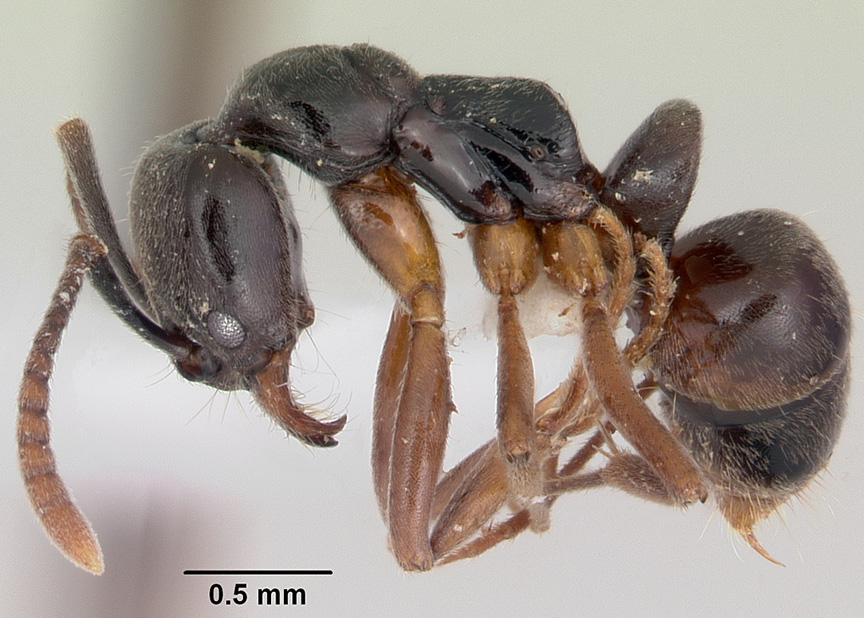
Pachycondyla chinensis Asian Needle Ant

One of the few ants that are specialized for cold temperature foraging; they can be found foraging even at near freezing temperatures, where they are often the only ants visibly active. However, their range does not extend into the far north, despite their cold tolerance.

Pachycondyla chinensis, the Asian needle ant, was first detected in the United States in Dekalb County, Georgia in approximately 1932. This species is an average sized, dark brownish-black ant with an evident stinger. It is considered an invasive species that establishes large populations that may displace native species. Reactions in humans from the sting o this exotic species range from mild to severe, sometimes with long lasting symptoms. Consequently, the Asian needle ant poses an emerging health threat throughout its range, as well as areas to where it may be spreading. However, it is not overly aggressive. Stings typically result from handling workers or by winged queens landing on individuals and becoming trapped between clothing layers and skin.

Asian needle ant typically nests in soil in somewhat damp areas, especially below stones, in rotting logs and stumps, or other debris. In urban settings it may also be found under mulch, railroad ties, bricks and pavers. Colony size ranges from less than 100 individuals to several thousand, and multiple queens may be present. Unlike many introduced, invasive ant species, it can nest in natural wooded habitats. This species appears to prefer termites as a food source.

This introduced species is thought to have been introduced from Japan. In the United States it is known to occur in Alabama (MEM record), Connecticut, Florida, Georgia, South Carolina, New York, North Carolina, Tennessee, and Virginia.

Sources:
Mississippi State Entomological Museum, Asian Needle Ant
Wikipedia, False Honey Ant or Winter Ant